During my semester at sea abroad in 2014, I was able to collect litter off of the island of Honolulu, Hawaii. It was a real eye-opening experience and it made me think about how important it is to recycle.
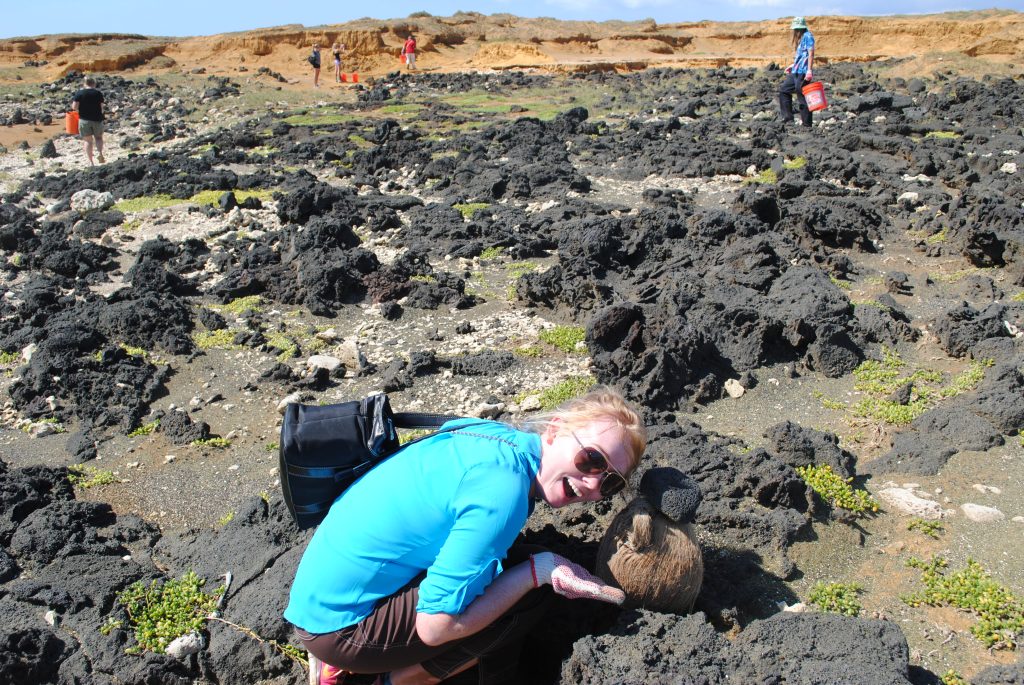
Image courtesy of Sissey
Today we would be invading Hawaii. At last, after a week at sea, the MV Explorer rattled and rocked like a buzz saw and came to a complete and jittery stop at the Port of Hilo. I was bursting with anticipation like hot lava volcano that was about to boil over.
Swarms of students filed into vertical lines, waiting patiently for disembarkation with
ID’s in hand. I peered over a multitude of shoulders to catch my first glimpse of Hilo. Bright. Lush. Green. I saw light and dark hues with unexpected tropical plants the size of giant shields looming in the distance. I could spot a bushy jungle of palm trees, waving their branches as if to welcome me. Like I had read in Mark Twain’s “Letters from Hawaii”, while he landed in Kailua, he mentions a “little collection of native grass houses reposing under tall coconut trees—the sleepiest, quietest, Sunday-est looking place you can imagine. Would I see something similar? My thoughts were interrupted abruptly by a loudspeaker. “Okay everyone. Immigration is over. You’re now free to leave the ship,” said
Zaneeta Daver, our blessed Assistant Executive Dean, whose voice daily “sailed off” into our lives. Like prisoners released into daylight, we raced towards the gangway. A blast of tropical air swept across my face. I slathered SPF sunscreen onto my fairly freckled Irish skin, feeling like I was going to melt of course. The heat was a definite factor amongst the contrasting differences of this exotic land called Hawaii. Quite different from my small hometown of Wisconsin, an icy zero-degree winter I had left behind.
“Aloha everyone, welcome to Hilo!” said Cat Spina, our tour director. She sported
capri jeans and a relaxed smile. “You guys get to walk a mile collecting marine debris for your field lab,” she said beaming, waving towards the bus.
I contemplated while waiting in line what the day would bring. I had to admit. I was super hyped. Collecting marine debris may not be someone’s ideal activity when first landing their feet in Hawaii, but I was interested and willing to see how I could make a small difference to save some precious wildlife. I was prepared for an epic search of trash and duckies and all sorts of good stuff, like I had been reading in Donovan Hohn’s “Moby Duck” during class.
“So guys,” Cat said with a smile, “When we get closer to the site, you may notice it’s getting a little voggy.”
“Voggy?” I repeated, crinkling my nose as if I could smell something fishy. Cat nodded and explained this funky term meant volcanic fog. “Wow,” I said to myself, almost tasting the sulfur on my tongue. I pulled out my journal and jotted this new term to my limited Hawaiian vocabulary.
Cat continued to entice us by spewing off facts about marine wildlife. “So have you ever wondered why humpback whales come from all over the ocean, just to chill out at the Hawaiian islands?” she asked. I shook my head along with my peers.
“Since it’s shallow near our coasts, they can take care of their
calves easily and keep a watchful eye on them, away from predators.” During the drive I also learned that Hawaii is not only home to a rich environment of birds, but also rats and quirky animals like mongoose have over populated the island. This is a slightly unlikable problem.
“Each year, trade winds or current flows bring at least 10 to 20 tons of marine debris to Hawaii every year. The danger of swallowing plastics and other foreign objects for an animal is bad for us too. How about a plastic dinner?” Cat asked, while winking. She was poking fun, but the thought of a plastic dinner to me certainly wasn’t appealing. A hand popped with a question in the back of the bus.
“Does plastic ever decompose?” asked my fellow peer.
“Yes, but unfortunately, it degrades extremely slowly,” said Cat, raising her
eyebrows empathetically. We then met with Bill Gilmartin and his assistant Megan Lamson along Volcano Highway. Bill was in his rustic pickup truck, wearing cargo pants and a long-sleeved maroon coloured shirt. He was the kind of character I expected after reading about his signature pony tail in Hohn’s book.
“We need to be respectful of Hawaii’s natural beauty and it’s sacred wildlife”, said Bill, gesturing towards the gorgeous landscape. The thought that countless tourists continue to visit this beloved island each year was amazing, but what scared me what that I hoped it could always remain this beautiful. Bill had a vast and extensive knowledge of marine wildlife, speaking with assurance and a twinkle in his eye. I could tell he had a deep connection with the environment, which was inspiring.
We soon made a brief stop at Punalu’u Bakery—a delicious little pastry shop filled with
mango malasada doughnuts, peach-pineapple dainties, and coconut turnovers. Ugh. My mouth watered at the sight of Mauna Loa Macadamian nuts covered in thick, milky chocolate. We grabbed our lunch generously prepared by the team, and made a pit stop in the shade under a steep mountain. Megan wore her long, sandy blonde hair tied back under a Wildlife Fund baseball cap. She was a driven, tough n’ rough outdoorsy-type girl—the kind I always aspired to be like but couldn’t quite pull off like her. She was a natural when it came to nature. She explained we’d “talk story”—a Hawaiian term for “let’s chat dudes.”
Uncle, whom our tour guide charmingly called, was bronzed by the Hawaiian sun, wearing a white coral necklace and tank top. He strummed a peaceful song that could make palm trees sway, while his buddy next to him in camouflage hat and teal blue flowered shorts blew an airy tune on his flute.
As Hohn quoted in his book, “Travel is a fools paradise,” I was beginning to understand the meaning of the phrase.
Driving to South Point, blurred images of tin roofs and simple houses sped by. I
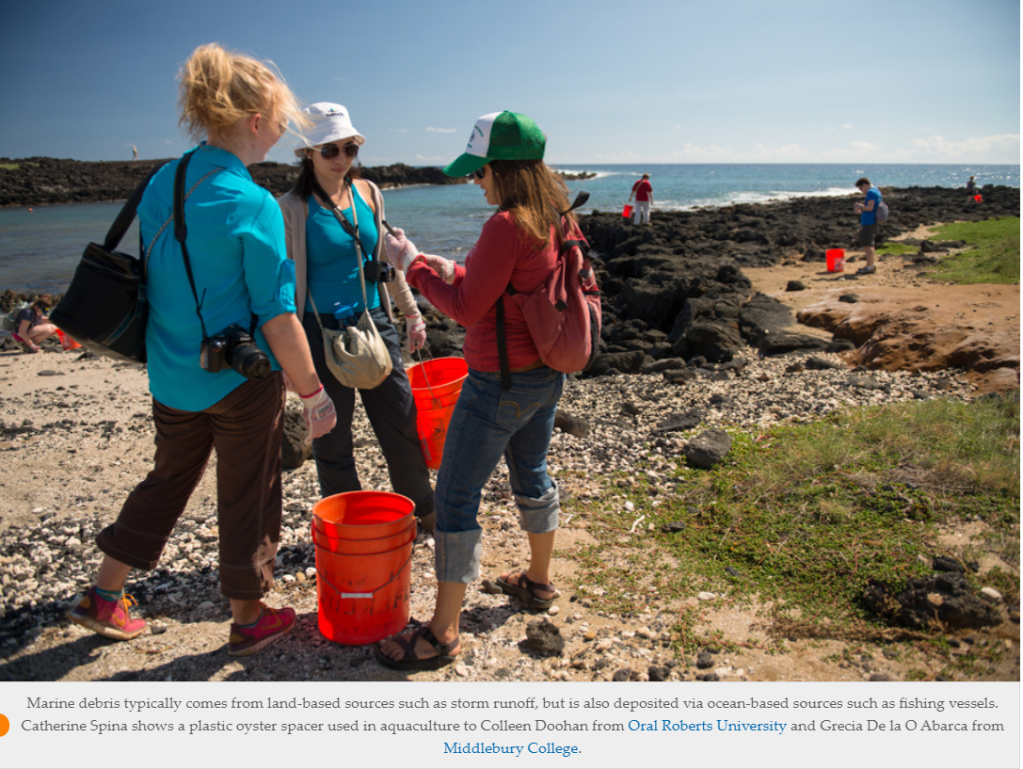
caught glimpses of coffee growing in it’s natural state as we passed the town of Kau. We drove around swirling coastal roads as our bus kicked up rural red dirt into the air. I twisted my neck in time to spot a Monkey Pod Tree, planted by Mark Twain himself. We finally arrived, and Megan gave us a wink and handed us each bright orange gallon buckets and gloves.
I was utterly shocked as I noticed the coastline consisted of degraded pieces of plastic that was shredded into tiny pieces. I was expecting something more like large plastic bottles scattered among debris. But this was awful.
“Keep your eyes peeled for treasures like oyster spacers,” said Cat. “They come all the way from Alaska or California.” Her faithful four-legged friend was wagged his tail, as if ready to pick up the trash himself.
Among the remarkable coastline were fishing nets and pieces of twine. Giant waves surged and crashed over the coastline of sparkling, jagged lava rocks, as black as coal mines that sparkled under the Hawaiian sun. I legit realised the meaning of Hohn’s book as I gazed at the waves and thought about how he said, “the thing about currents are, they’re so strong there’s no swimming against them.”
“Look guys, a whale!” Cat yelled. My thoughts were interrupted as my eyes followed her pointed finger to…not one, not two, but three whales! A sharp sting of hope rose inside me. Perhaps if more people got involved, pitched in or volunteered by removing marine debris and other foreign o4 invasive materials that Cat, Megan, or Bill mentioned, maybe we’d have hope that the natural habitat could still thrive. The whole cliche “do your part” as a responsible citizen and recycle—or “go green” as they put it may sound cool, but to actually see nature in it’s alarming danger was different. To see garbage. Trash. It was heartbreaking. That’s right. Rubble. Endless displays of grounded plastic, scattered among the rocks and crevices. That’s when it became real to me.
A speckled orange crab—the colour of a mango Push-Popsicle—scampered out of its dark hole onto a bubbly-shaped lava rock. I examined the tiny little guy basking lazily in the sun. What was it like to have watched the flaming molten lava as it slithered off the coastline into the ocean, bright and piping hot like a furnace blazing with fire? Everywhere, I saw beautiful life. A place where people seek to bask in the Hawaiian sun from literally all points of the globe. And deep down, I hoped this priceless pearl would always be around to enjoy.
Before the day ended, we visited the Hawaiian Volcano Observatory, along with a cliff at South Point, and the Kilauea Halemaumau Crater. I watched volcanic lava rock steam rise gently to the sky. Walking through a lava tube for the first time, I smelled the fragrantly strong, stuffy smell of sulfur as we swept through the volcanic caves into the sunlight. We visited a black beach, and I got to feel the glistening dark shimmers of sand running through my fingers. And to our delightful surprise, our group spotted some happy turtles lazily hanging out in the sunlight—not a care in the world. I hoped these creatures the size of large pizzas could always remain wet, wild and free. Free of plastic, of a jungle of junk. Wild, natural beauty I decided, is something that can’t be bought, borrowed, or most certainly wasted. It’s something to be treasured—like a priceless family heirloom in a dainty jewel box.
By the end of this long day, my sneakers were full of sandy red dirt. We were hot,
sweaty and tired. Megan passed out Aloha Maids and Guava juice to us thirsty travelers,
which was a true display of the spirit of “Aloha”. I think I realized that Hawaiian culture consisted of a pride of the land. The people I met were warm and welcoming, carrying a hospitality and sharing their exotic world with sincerity that only the “Aloha” spirit could captivate. In one short day in Hilo, I discovered how the people were eager to welcome us with open arms as new comers.
Jumping back into the bus all hot, sweaty and sandy, I wiggled a chocolate Macadamia nut Kona bar from the 711 store into my pocket. I waved goodbye to Hilo sands as we rolled back to our vessel that waited for us in the port. With the help of twenty two eager participants, we had officially partaken in the great Kaulana-Ka Lae cleanup. We removed sixty three pounds of garbage from the coastline. A small, yet helpful start to a cleaner Hawaii.
❦
To find out more information about marine debris, visit the blog by Semester at Sea HERE
 Home
Home 