
Image courtesy of Marianna Michael
“We need nature where nature is void. Now, more than ever, it’s almost a demand or a necessity. Homes are becoming smaller and cities are becoming cramped with boxy apartments. Populations are growing, wages are becoming less…it’s not enough for your desired—or in some cases, non-existent lifestyle.”
—Marianna Michael, Writer
At the age of 19, Marianna Michael began a mixture of internships and short courses which helped aid in the guidance of carving out a path for her career.
“My life was centered around art and fashion. I fell into writing almost accidentally after art-school, after having a tough time with my mental health,” says Michael. “Mix that with admissions issues to get the BA course I wanted…I took some time to essentially contemplate my future.”
At this point, Michael knew that she needed to turn back to her first love—which was writing.
“I realised that storytelling in various formats could become a career…that’s how I found my imagination could fulfill any moment of boredom. I got into writing seriously a lot later,” says Michael.
With this natural aptitude and gift for writing, Michael continues to mesh her knowledge of architecture with her love for sustainability. Her latest work includes a piece she wrote in December called Sustainability in the Construction Industry: How their Methods can be Utilised within Fashion, written for Not Just A Label, a community infusing sustainable voices in the face of modern fashion.
Re-thinking landscape, Michael set out to explore the possible solutions that sustainability could have in unexpected spaces like construction. An excerpt from her piece reads:
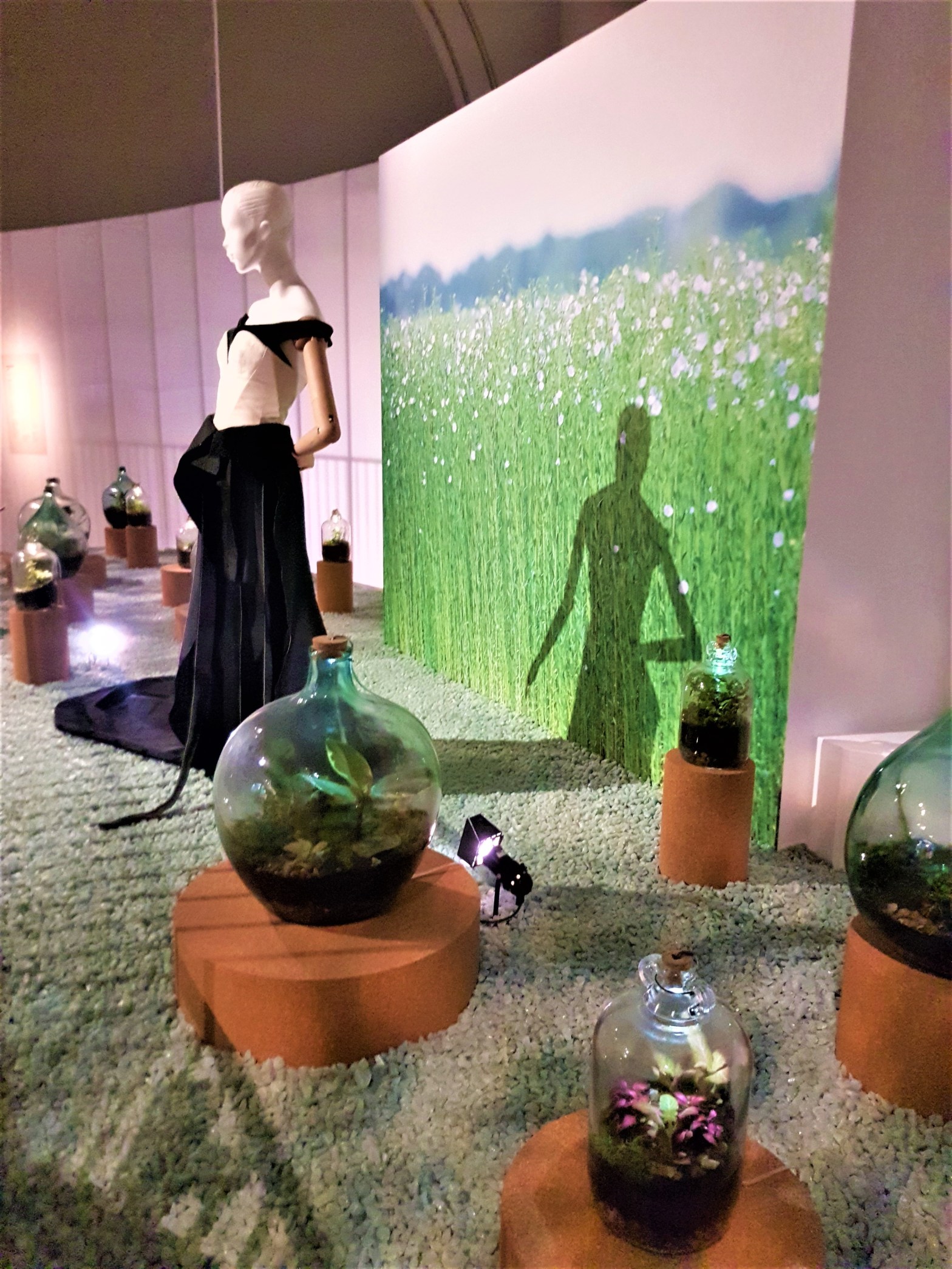
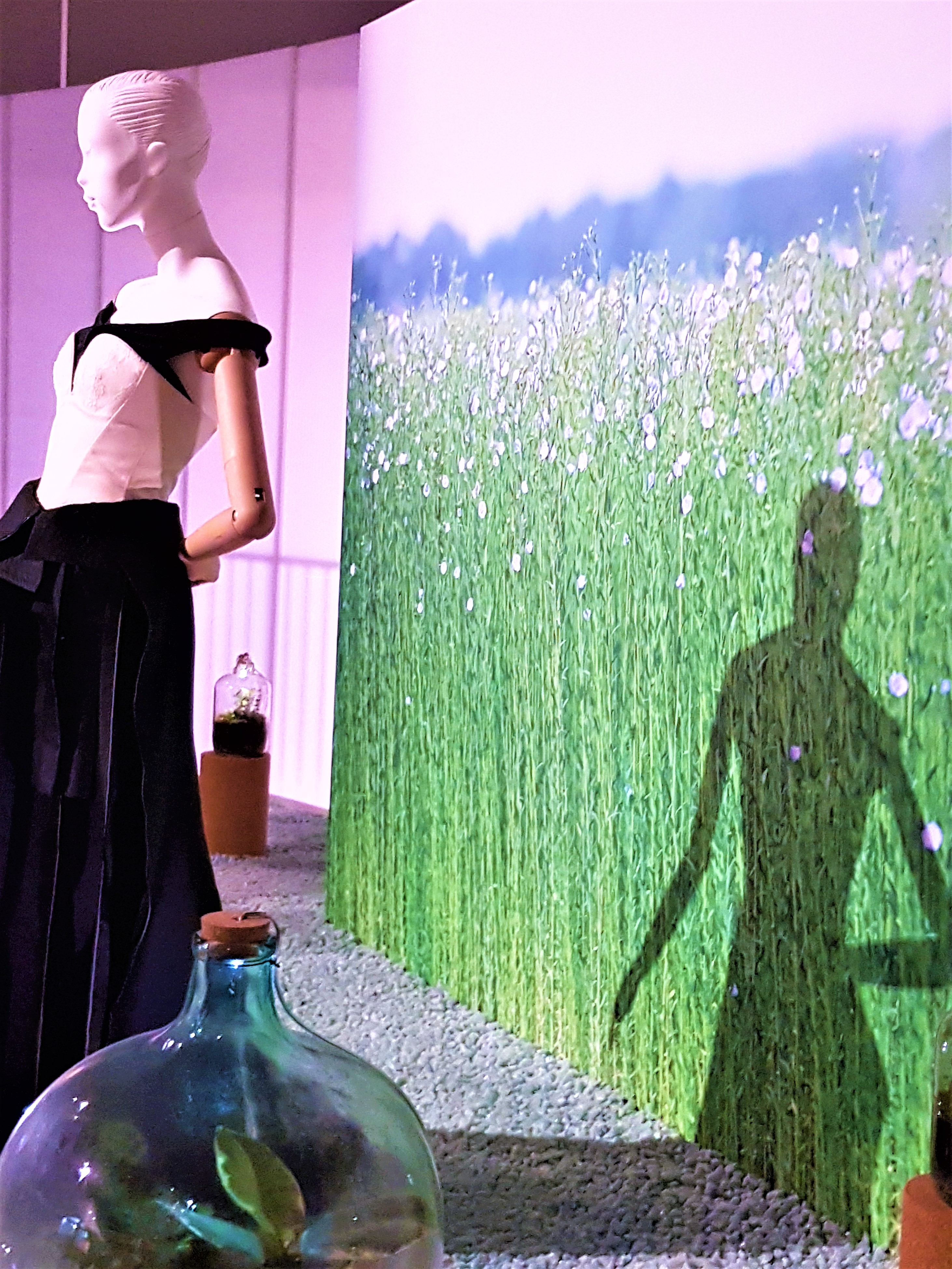
“As seen in the V&A’s Fashioned From Nature exhibition, “fashionable dress alongside natural history specimens, innovative new fabrics and dyeing processes” come together frequently. And yet the fashion and textile industry has led to intensive land use and loss of nature—destroying the very thing that is both practically and creatively vital.”
Michael continues explaining how construction and fashion have similar behaviors, both in a shared concern for protecting nature, wildlife, eliminating contamination, and preserving moral principles. But this sustainable diva also has a love for shrubs.

“I’ve always loved aesthetics. For me, it possibly derived from my cultural upbringing,” says Micahel. “I recall visiting relatives growing up who would have these incredible indoor plants…it felt so jungle-like to me…and as I looked more into spacial and architectural design—along with well-being and lifestyle—I started to understand the links between mental well-being and nature. It’s something that architecture and interior design have often encompassed.”
This talented artist has earned her foundation diploma in Art and Design at Central Saint Martins, along with studying Visual Merchandising and Display at the London College of Fashion. She also has an interest in film, having attended UCLA for Screenwriting Fundamentals.
“I can never tell if it was because I was an only child, or my upbringing in general, but I was always encouraged to entertain myself,” says Michael. “I teetered with the thought of going into musical theatre and working backstage also played on my mind. But at an early age I was led to believe it was a male domain.”
So how did she steer through these obstacles in life to land back at her journey in the beginning, to her central passion in writing?
“I was taking every film course I could, whilst keeping up with freelance jobs and internships,” says Micahel. “But I had an epiphany of just how much I was neglecting the real thing that I truly wanted to do. This is when I got into film school, and I was taking other short art courses, too, soon realising just how much I wanted to be a writer.”

Michael, who is currently an assistant at Enfield museum, says that she draws a lot of inspiration from the brilliance of architecture.
“I’ve always had a love for architecture…my father is a planning engineer, which allowed me access to not just his knowledge, but also his various places of work,” says Micahel. “As a teenager I joined mentoring schemes and placements within companies he was working at, giving me insight into architecture beyond the facade. I’m very fond of Brutalist architecture, but equally inspired by very ornate structures, whether that falls into Rococo, Victorian or Renaissance styles. Despite this, Frank Lloyd Wright and Frank Gehry are two of my favourite architects.”
A brilliant thinker of his time, Frank Lloyd Wright spoke about subjects that unified nature and the relationships that humans have with it. He believed that through architecture, we could have a symbolic relationship and live in harmony with the environment, using it as a guide for inspiration and insight into how we could think and do things better.

So could this theory of being surrounded by lustrous herbs prove to be an accurate notion? Michael has unwavering confidence that yes, it can.
“We need nature where nature is void,” says Michael. “Now, more than ever, it’s almost a demand or a necessity. Homes are becoming smaller and cities are becoming cramped with boxy apartments. Populations are growing, wages are becoming less…it’s not enough for your desired—or in some cases, non-existent lifestyle.”
Micahel is no stranger to DIYs, and has a couple of tips for students looking to create something chic and sustainable.
“My friend actually made a handwoven piece…she does it using bits of branches that she finds in the park. It’s quite an easy thing to do—I highly recommend having a look online,” says Michael.
Over the years, Michael says she’s gathered her home décor either simply as a result of functionality or just by keeping up with the trends.
“I’ve fallen into the trap of being a millennial whose bedroom is also their office and studio,” says Michael. “It’s somewhat awkward in positioning furniture and spaces between windows…in a rush I had to finish my room when it needed renovating due to water damage. I ended up buying everything with very little thought.”
But Michael has mastered the craft of upcyling, and for a crafty DIY, she suggests the following steps you can try at home:
- Gather some A4 scraps of wallpaper (ordered as free samples or collected from wallpaper merchants).
- Place a postcard from a gallery or museum. Michael says artwork from exhibitions work great.
- Place these in the very centre of your piece.
- Frame it in a cheap A4 frame.
- Voila! Simple. Done.
“I love the idea of playing with purpose,” says Michael. “Why does something have to be used for its intended purpose? I know lots of people who have done incredibly interesting projects with objects that would otherwise be thrown out. I had a dresser I didn’t use for its intended purpose…I removed the mirror, drawers and glass top. It was fine—minus the two small holes on the top where screws used to be—but I got fed up with the holes and bland white table, bought some wood-effect sticky back vinyl, and covered the top.”

Want some eco-friendly advice? Follow Marianna’s Marvelous Top 5:
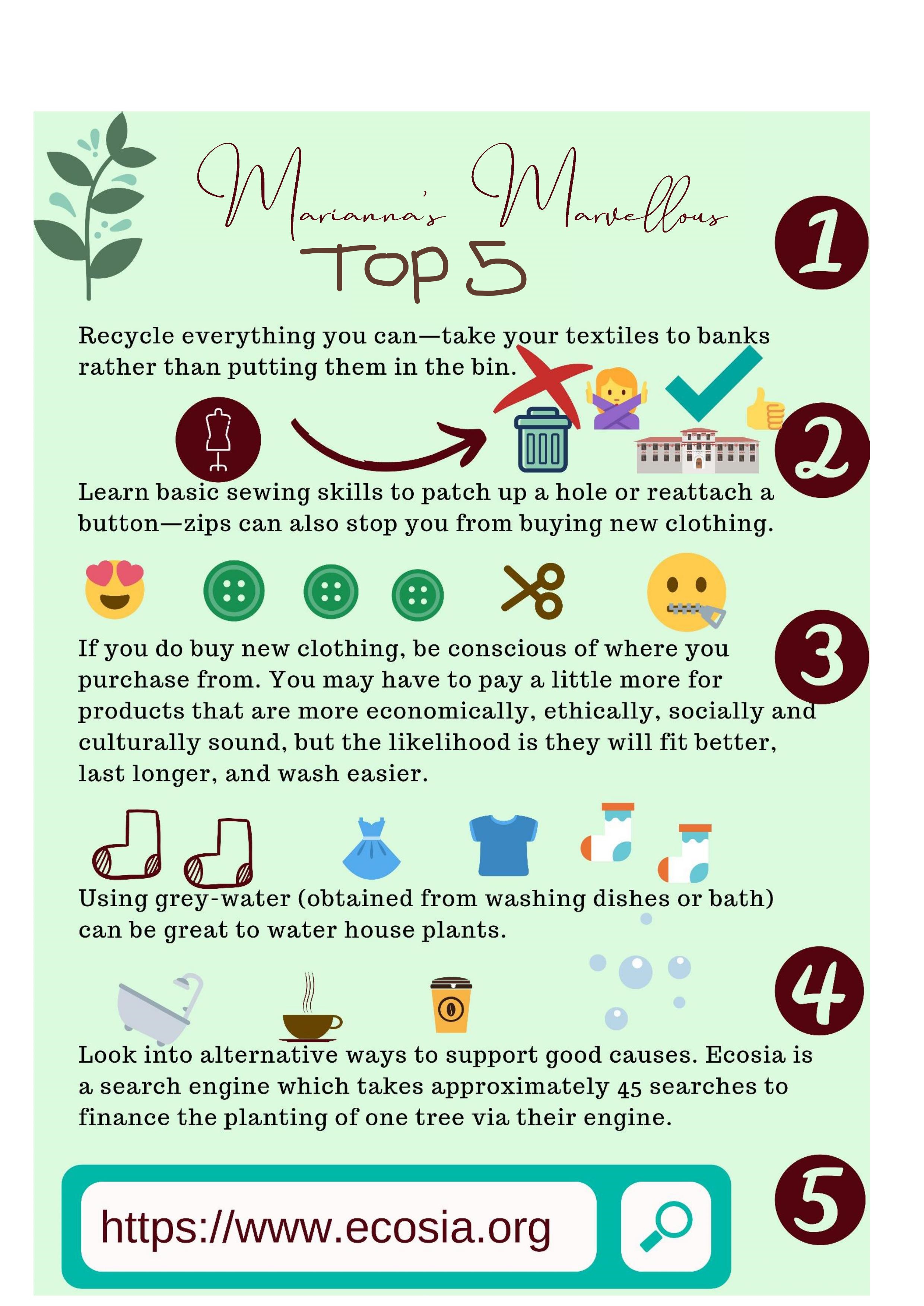
- Recycle everything you can—take your textiles to banks rather than putting them in the bin.
- Learn basic sewing skills to patch up a hole or reattach a button—zips can also stop you from buying new clothing.
- If you do buy new clothing, be conscious of where you purchase from. You may have to pay a little more for products that are more economically, ethically, socially and culturally sound, but the likelihood is they will fit better, last longer, and wash easier.
- Using grey-water (obtained from washing dishes or bath) can be great to water house plants.
- Look into alternative ways to support good causes. Ecosia is a search engine which takes approximately 45 searches to finance the planting of one tree via their engine.
These steps can be easily added to your life. So simple, yet so profound. Following ideas like these can help you in your own personal journey of sustainability, helping you spread awareness and bringing the message to your friends, family and colleagues.
“Don’t beat yourself up about slipping up every once in a while,” says Michael. “Money is a constraint, as is the availability of certain products that can be recycled or that are eco-friendly. Re-useable travel cups, water bottles and bags are a great first step. Cutting out single-use plastics entirely is one of the best things, but it’s tough, given the availability of products that come without it. Thankfully, package-free products and shops are making more frequent appearances. Buying local also helps strengthen the local economy, as well as reduce carbon footprints that arises from transportation.”
Michael sums up her hope for the future in this perfect phrase:
“If we look at the future of our cities and technologies, as well as climate change mitigation and want to avoid a dystopian future—green roofs, walls, interior gardens, and other organic concepts, could have a strong impact on the future.”
Find out more about Michael’s work by following her site or blog. Don’t forget to visit her Instagram page, and for some inspiring ideas you can follow her Pinterest board all about architecture here.
❦
 Home
Home 